One of the great attractions of a custom yacht is the freedom to question the conventions of yacht design. However, every extra metre of accommodation, every additional deck and every sizeable piece of equipment has implications elsewhere in the design.
Understanding those compromises before the plans are finalised can make an enormous difference to the cost, capability and enjoyment of the finished yacht. Some decisions are relatively easy to reverse; others may require a major refit.
Developing Your Custom Yacht Design Brief
Before you look at designers' portfolios, give some thought to how you intend to use the yacht. Will you spend most of your time aboard with your immediate family or regularly entertain large groups of friends? Do you intend to cruise throughout the year or spend a few weeks each summer in the Mediterranean? The answers may have more bearing on the design than any particular style of yacht that has caught your eye.
When shipyard founder Frans Heesen and his wife Petra commissioned their own 46.7m (153ft) yacht, Lady Petra (now Odyssea), they gave the prime space forward on the main deck to a cinema and games room for their grandchildren. Their own suite occupied the upper deck, where they could enjoy a little peace and quiet away from the younger members of the family.
Think ten or fifteen years ahead, too, as children may outgrow a shared cabin, while older relatives might find stairs increasingly difficult. Lady Petra also had lifts between decks and equipment to help guests with limited mobility get into the sea. A lift shaft is considerably easier to accommodate on a drawing board than it is to retrofit through the decks of a finished yacht.
If this is your first large yacht, chartering a few yachts of comparable size and with different layouts is money well spent. Pay attention to which spaces you use, where you eat most of your meals and how much privacy you actually need. You may find that some of the features high on your original wish list are rather less important after a fortnight at sea.
Should I Choose a Builder or Designer?
Many yacht builders provide comprehensive internal design support, yet they are equally open to collaboration with independent designers or studios. If you are drawn to a builder's distinct design DNA or captivated by the elegance of their previous yacht creations, opting for their in-house design team can ensure a seamless integration of your vision. Alternatively, if a particular independent designer has caught your eye, their unique artistic flair might be the perfect fit for your project.
While independent designers strive to showcase the vast range of possibilities they can offer, it's important to acknowledge that each designer often possesses a distinctive style. This style spectrum spans from minimalist aesthetics to the avant-garde, allowing you to align your preferences with a designer whose artistic sensibilities resonate with your vision for the ultimate custom yacht.

Buyers often come to the yacht customization process with preferences based on existing yachts they admire, serving as valuable reference points to shape the initial stylistic direction. On the flip side, builders or design studios may present pre-existing concepts tailored to various sizes and styles, potentially serving as a solid foundation for the project and speeding up the early stages of the custom yacht build process.
Alternatively, you may already have a clear idea of the yacht you want or prefer to start with a blank canvas. The challenge is to establish what is technically possible and how much it will cost.
One advantage of appointing an independent designer before choosing a shipyard is that you can put the same outline design and specification out to tender. Do check what's included in each quote, though. A lower price may simply reflect a less comprehensive technical specification or a lower allowance for the interior fit-out. It's also worth establishing at the outset whether your design agreement gives you the right to take the plans to a shipyard of your choice.
When assessing a designer's portfolio, pay particular attention to the yachts that have actually been built. Ask what responsibility the studio had for each project and, if possible, speak to the owners or captains of previous builds. There's a world of difference between an impressive computer rendering and a yacht that has spent several years at sea.
Yacht Design Trilogy
The design of a custom yacht draws on three main disciplines: exterior design, interior design and naval architecture. Each requires a different set of skills, but the three are closely interlinked. A change to the exterior profile can affect the space available inside, while the weight and position of interior features can have implications for the yacht's stability.
Exterior Design
The comprehensive design of a yacht, encompassing the exterior features, styling, layout, and decks from the waterline upward, can be expertly managed by either an independent design studio or the in-house team of the construction yard. Collaborative efforts are not uncommon, where an independent designer collaborates with the yard's design team to create a cohesive vision.

Some exterior designers also take responsibility for the interior, right down to the door handles and furniture, while others work alongside a specialist interior designer.
It's worth studying the exterior profile alongside the general arrangement (GA) and cross-sectional drawings. A particularly low or rakish superstructure may look wonderful in profile but leave less headroom inside, while the height and position of the windows will determine how much of the view you can enjoy from a seat in the saloon.
Interior Design
The interior designer's remit can extend from the layout of the yacht to the choice of furniture, fabrics and finishes. Much of their most valuable work takes place long before any material samples are laid out on a table.


Take the formal dining room. If you eat almost every meal outside, does it really warrant a sizeable chunk of the main deck? The owners of the 63.72m (209ft) Royal Hakvoort Scout dispensed with a fixed indoor dining room altogether. Instead, H2 Yacht Design equipped the forward observation lounge on the owner's deck with tables that rise to dining height. An adjacent service pantry and food lift allow the room to double as a dining area when the weather turns.
By contrast, the Numarine 40MXP we toured has a sizeable dining table in the main saloon, with a bar close at hand and easy access to the galley. On a yacht with so much guest accommodation, there's a good case for an indoor dining area where everyone can sit down to eat together.
If you've already appointed a captain, ask them to go through the general arrangement with the chef and chief steward before the layout is finalised. How far does a hot meal have to travel from the galley to the dining table? Can the crew clear away afterwards without traipsing through the guest lounge? Even something as simple as a well-placed pantry gives the crew somewhere to clear plates and pour drinks without constant trips back to the galley.
Naval Architecture
The hull design, including the choice of hull material, falls within the remit of the naval architect and has a major bearing on the yacht's performance, handling and stability. The dimensions of the hull and superstructure also determine the yacht's enclosed volume, on which its gross tonnage (GT) is based. A particularly tall superstructure or heavy equipment on the upper decks can raise the yacht's centre of gravity, so the naval architect has to account for the weight and position of everything on board.
While the option exists for an independent designer to undertake naval architecture, it is more common for the chosen shipyard, selected for its expertise in constructing yachts of the desired size and specifications, to provide existing and proven designs adaptable to support the overall yacht design.
The advantage of a proven platform is that much of the engineering work has already been done, from the position of the fuel tanks to the space allocated for cable runs and pipework. However, any substantial changes to the layout or machinery specification will need careful assessment.
Ask the naval architect how much allowance has been made for future increases in weight, too. You may want to replace the original tender with something larger in a few years' time, or fit additional equipment during a refit. The Cayman Islands Shipping Registry specifically advises owners of commercial yachts to allow for future weight increases at the design stage to help protect the yacht's stability.
It's also worth involving an experienced chief engineer before the machinery spaces are finalised. There's little point in squeezing an impressive amount of equipment into an engine room if you have to remove half of it to change a pump. On the Bering 88 we toured, there are three separate routes into the machinery spaces and clearly labelled pipework with arrows to indicate the direction of flow. These are the sorts of details worth specifying from the outset.
Glass, Windows and Glazed Structures
On a modern superyacht, huge windows, glass bulwarks and sweeping curved panes need to do far more than frame the view. Glass forms part of the yacht’s weather- and watertight skin, so its size, shape and position all have consequences once the boat leaves the dock. Wave pressure, hull movement and structural flex all come into play, which means a design flourish on the drawing board can quickly turn into a fairly serious engineering exercise.
The weight can also creep up faster than you might expect, especially with large panes lower down in the yacht where the loads are greater. Even a small increase in glass thickness can call for a much larger increase in ballast, which then cuts into the yacht’s available deadweight. So while acres of glass may look like an easy win, there can be a knock-on effect elsewhere in the design.
Large glazed areas can also admit a great deal of solar heat, so insulation, tint, coatings and light transmission all need to be thought through early rather than patched up later with blinds and energy-guzzling air-conditioning. Curved glass can complicate matters further because some strengthening methods restrict the coatings that can be used, so the cleanest-looking solution is not always the easiest one to live with.
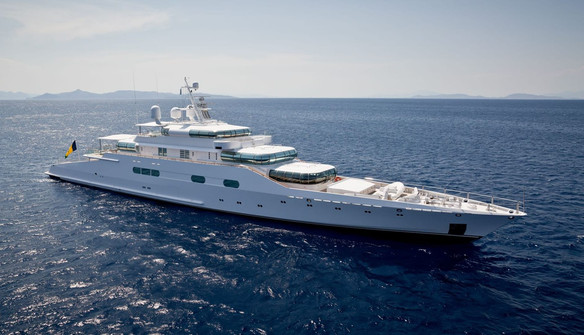
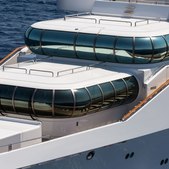
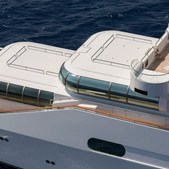
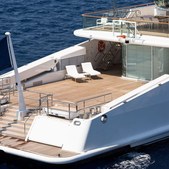
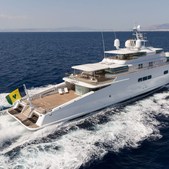
Optical quality matters most where the crew need a clear view, particularly around the bridge, but curved glass can also become part of the yacht’s whole identity. Zeus is a great case in point: her three tiers of convex glazing were radical when she launched as Eco in 1991 and still define the yacht today. The curves were shaped in part to cut internal reflections, which shows how glass can solve a practical problem and make a bold design statement at the same time. Get it wrong, though, and distortion, fabrication limits and structural demands can quickly take the shine off the idea.
Zeus: A Case Study of Curved Glass
Guests
15
Cabins
6
Crew
21
Custom Yacht Design Features
Custom yachts have pioneered many of the design features now found on smaller production yachts. One of the advantages of a custom build is the freedom to decide how much space to devote to these features and how best to incorporate them into the overall design.
Beach Club
Usually situated at the stern, a yacht's beach club provides a leisure area close to the water. Fold-out terraces can extend the usable deck space at anchor, while hydraulic bathing platforms can make it easier for guests to get in and out of the sea and for crew to launch water toys.


One of the key decisions is whether to have a permanent beach club or a space that doubles as a tender garage. If it's the latter, how much of the beach club can you use before the tender has been launched? Our guide to yacht stern design looks at the merits and drawbacks of the various arrangements in more detail.
Main or Upper Deck Owner’s Cabin
An owner's cabin on the main or upper deck benefits from larger windows and may have direct access to a private terrace or balcony. A main deck suite has the advantage of being on the same level as the main saloon, while an upper deck suite can offer greater privacy and more elevated views, albeit sometimes at the expense of a second guest lounge.

Luxury defines the amenities within the owner's Cabin. A lavish en-suite bathroom, a comfortable sitting area, and personalized storage solutions are standard features. The interior design is a reflection of the owner's taste, incorporating bespoke furnishings, premium materials, and a cohesive color palette.
On the Benetti B.Yond 37M we toured, the owner's suite occupies the bridge deck and has its own aft terrace with no access from the side decks. The only way onto it is through the owner's cabin. This arrangement also frees up much of the main deck for four guest cabins and their own communal lounge.
Don't assume that a main deck owner's suite means everything is on one level, though. On the Ocean Alexander 37L we reviewed, the raised bed makes the most of the wraparound windows, but there are steps down to the dressing area and bathroom. It's worth studying the cross-sectional drawings as well as the deck plans before you settle on a layout.
Sun Decks
Sun decks on custom yachts are designed to provide an exclusive and open-air space for relaxation, entertainment, and sweeping views.
Guests can enjoy panoramic views of the surrounding seascape, with comfortable lounge areas with plush seating, sunbeds, and sometimes private cabanas for relaxation and socializing in the open air. These decks often include dining areas with tables and seating for alfresco meals against the backdrop of the open sea.

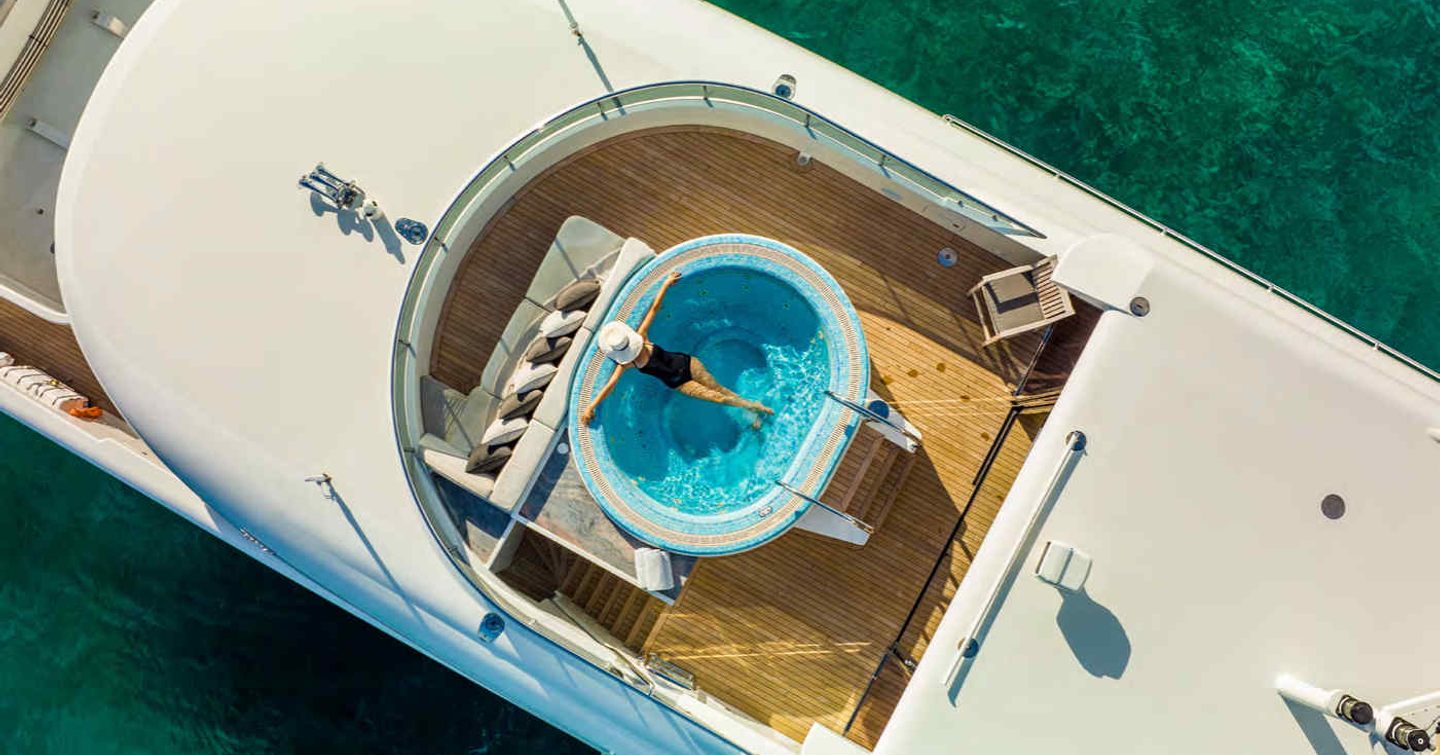
Wet bars, outdoor dining areas, hot tubs and entertainment systems are all popular additions to a sun deck, but don't underestimate the importance of shade and shelter.
On the Gulf Craft Majesty 145 we toured in Dubai, sliding doors across the sun deck allow guests to shelter from the wind without losing the benefit of an open-air dining area. The choice of black stone for the bar worktops was less sensible, given how hot they can get under the Gulf sun. It's worth giving as much thought to the materials and protection from the elements as the amount of space available.
Gyms and Wellness Facilities
Headroom can be a problem in yacht gyms, particularly if you want a treadmill. For someone who is 1.8m (5ft 11in) tall, certain commercial treadmills require a finished ceiling height of 2.38m (7ft 10in), considerably more than is available on many yachts.
Some of these machines weigh upwards of 200kg (441lb), so the yard needs to know what equipment you intend to install before it designs the deck structure. Check the width of the doors and passageways as well. You need to be able to get the equipment out again once the joinery is in place.
Ideally, avoid siting the gym directly above a cabin, where the thud of feet on a treadmill or dropped weights can disturb anyone asleep below. The air conditioning also needs to cope with the extra heat and moisture generated by exercise.
Swimming Pools
Contrary to popular belief, very few yachts have pools, but those that do, have them seamlessly integrated into the yacht's design, offering a private oasis for relaxation and recreation.
Positioned strategically, these pools often grace the aft deck, providing stunning views of the ocean while guests enjoy a refreshing swim. Some custom yachts take innovation further by featuring infinity pools or pools with transparent walls, creating a mesmerizing connection with the surrounding waters.

Glass-bottomed pools and transparent pool walls sit in much the same engineering territory as underwater windows. The glazing has to cope with long-term hydrostatic pressure, while the stiffness of the laminate and its interlayer also become part of the calculation. Because these panels are often thick and highly restrained, engineers need to work out the effective glass thickness carefully rather than assume the laminate acts as one solid pane. The weight of the glass and the pool water also has to be increased to allow for the accelerations created by the yacht’s movement.
Movement creates another headache once the pool is full, because even small yacht motions can set the water sloshing. Feadship has gone quite a long way down this rabbit hole with its ContraWave system, which uses an air chamber and hidden pipework to absorb wave energy before it builds. Its research also found that water depth, pool steps and drain design can make a measurable difference; horizontal drain openings, for example, provided twice the damping effect of vertical ones in its tests. Filtration and water treatment then sit alongside all of this as a separate job, keeping several tonnes of moving water clean as well as under control.
Some yachts even turn machinery heat into a useful asset. On superyacht Obsidian for example, waste heat from the generators and air-conditioning chillers is reused for the pool, domestic hot water, HVAC and engine pre-heating, rather than simply dumped overboard. Breakthrough takes the idea further still, with recovered heat used for its pool, Jacuzzi, steam room and even heated bathroom floors.
Submarine and Toy Garages
The choice of tender can have quite a bearing on the design of a yacht's garage. Length and beam are only part of the equation. There also needs to be enough clearance above the tender for the crane and lifting gear, particularly if it has a fixed hardtop. The crane's lifting capacity needs to account for the weight of fuel and equipment aboard the tender, not simply its quoted dry weight. Our guide to tender launch and recovery systems explains the various options.

A submersible is a rather more complex proposition. Aside from the garage itself, you'll need specialist launch equipment, charging facilities and trained personnel. Establish whether passengers can remain aboard the submersible during launch and recovery or whether they need to transfer once it's in the water. That has implications for the crew, the equipment they need and the sea conditions in which they can operate.
There comes a point when it may be better to house all this equipment on a separate vessel. The 66.2m (217ft) catamaran Hodor, designed by Incat Crowther, has a beam of 14m (46ft) and carries everything from a submersible to a 17m (56ft) tender. That's an awful lot of equipment to accommodate on the mothership without sacrificing guest space.
Dive Center
An onboard dive compressor comes into its own in remote cruising grounds, where there may be nowhere ashore to refill your cylinders. The position of its air intake is critical. Too close to one of the yacht's exhaust outlets and there's a risk of carbon monoxide contaminating the air in the cylinders. Get a specialist involved at the design stage and make sure the air quality is tested regularly.
Wet dive kit is heavy and awkward to lug around a boat, so it helps to have the cylinder racks, freshwater rinse tank and ventilated lockers close to the bathing platform. A bench where you can sit to put on your kit is well worth having.

A bathing ladder that's perfectly adequate for a swim can be quite a struggle with a dive cylinder strapped to your back. A dedicated dive ladder or a suitable hydraulic bathing platform that lowers into the water makes life considerably easier.
Discuss your plans with the captain and a dive specialist before the layout is finalised. You'll need suitably trained crew to fill the cylinders and run the dives, as well as enough emergency oxygen to account for how long it might take to reach medical help.
Final Thoughts
The beauty of a custom build is that you can tailor the yacht to the way you live, but every design decision has a knock-on effect elsewhere.
By all means pore over the renderings, but ask the designers for a set of deck plans with the yacht rigged for sea. Where does all that loose deck furniture go? How much usable deck space is left once the terraces are folded up and the tenders are back on board?
If you intend to cover long distances, a decent sheltered spot to sit under way could be of far more use than another few square metres of sunbathing space at anchor. These are the sorts of compromises you want to thrash out with the designer while they're still relatively cheap and easy to resolve.
Related articles